![]()
![]() |
Remembrance BookIn Honorof our Camp'sConfederate Ancestors |
![]() |
(Click on Camp Members' ancestor's name to go to information) (See our companion page Remembrance Book II of Lake County Veterans, link at bottom)
8th Brigade Cmdr. Harry D. Hurst: Enoch Wiley Hurst , Andrew Young Allen
Commander Terry F. Binkley: Benjamin F. Binkley, William R. Surface, Jesse P. Shamblin, Henry C. Binkley
Adj./1st Lt. Cmdr. James E. Binkley Jr.: Benjamin F. Binkley, William R. Surface, Jesse P. Shamblin, Henry C. Binkley
2nd Lt. Cmdr./Ass't Chap. James E. Binkley Sr.: Benjamin F. Binkley, Henry C. Binkley
Treasurer Stephen Robertson: Lt. Gen. John Bell Hood
Judge Adv. William A. Milton Jr.: Pvt. William Riley Milton (Our Camp Namesake)
Chaplain Dun Gordy: Gilbert Perry Gordy
Benevolence Officer Jim Baumgardner: James M. Baumgardner
Bob Blackmer: Elon God Blackmer
Tommy Carlisle, Sr.: Andrew E. Wade
William Carlisle: Andrew E. Wade
Lewis Fussell: Benjamin Anderson Fussell
Thomas Kelley: Frederick Southgate Hipkins, Richard Hipkins
William S. McClelland: James M. McClelland, William R. McClelland
Steve McGillivray: James Daniel Beatson, Pvt. William S. McGillivray
William T. Mills: Henry Lucius Mills
Robert H. Moody: William Andrew Hoss
Paul Mott: Levi Berry Long
G. Richard Singeltary: Richard W. Singeltary
Col. Sterling Wood: General Sterling Alexander Martin Wood
Ancestor's Stories
2nd Lt. Andrew Young Allen
Ancestor of Harry D. Hurst
Lt. Allen was born in Brunswick Co., Virginia in 1815. When he was a young man, he married Miss Rossanah Tyner, whose father was Capt. Jonathan Tyner, a veteran of the Seminole Indian Wars. It is not clear when or why Lt. Allen came to Florida, but he served as a 1st Lieutenant in a company of Florida militia during the Seminole Indian Wars. In just a few years the aging veteran would find himself in harm’s way once again with the invasion of the South by Federal forces. On May 20th 1864, at Lake City, Florida, at the age of 49, Andrew enlisted in Co. “G” 1st Florida Reserves, commanded by Colonel J. J. Daniels and Lt. Col. William D. Barnes. The reserves were the last line of defense for the Confederate States and they fought valiantly to defend their homes and families. The 1st Florida was no different and they acquitted themselves well at such battles as The Battle of Natural Bridge on March 5th 1865. Lt. Allen survived the war and raised a large family of six children. A true Florida pioneer and Confederate patriot, he now rests in peace with his family close to him at Orange Hill Cemetery in Williston, Florida.
James M. Baumgardner Ancestor of Compatriot Jim Baumgardner.
Below is a copy of his obituary taken from the local newspaper at the time of his passing. Notice the respect and honor given to this Confederate veteran at the time. We are honored to have this hero among the ranks of our ancestors and proud to have his descendant as a member of our camp.
The Huntington Herald-Dispatch, Friday Morning, October 23, 1914, pg. 12
VETERAN CALLED TO JOIN HOSTS IN PEACELAND
Venerable James Marion Baumgardner Lays Down
Burden
of Years for New Life.
SERVED GALLANTLY THROUGH CIVIL WAR
Funeral Will Occur This Afternoon Under Auspices
of Camp
Garnet Confederate Veterans
James Marion Baumgardner,
veteran soldier and pioneer resident of Huntington and Southern West Virginia,
died at three o'clock Thursday morning, at his home on Ninth street, where he
had resided for many years. Mr. Baumgardner, who was eighty-five years old, was
stricken with paralysis seven weeks ago. He lingered, fighting gallantly with
the aid of devoted friends and family, but owing to advanced age and the
severity of his affliction, he lost slowly, and the life that had once
represented a tower of strength, slowly ebbed into the shadows. Though
speechless, during all the weeks of his illness, Mr. Baumgardner was conscious
almost to the end, and frequently gave evidences of recognition to those around
him.
He was born near Ona, in Cabell county, on March 21, 1830, on the MacCorkle
homestead, one of the oldest properties in that section of the county. His
parents were Jacob and Mary Baumgardner, who came from
Fincastle, Va., to this section
early in the Nineteenth century. In his boyhood he evinced in a marked degree
qualities of vigor and intelligence and a capacity for work to which he held
steadfastly until the encroachments of age forced him into the quietude of
retirement. At the first outbreak of the Civil war, being of warm southern
sympathies, he enlisted in the Confederate army, and served gallantly to the
end. He participated in the battles of Scary, Carnifax, Morristown, Lewisburg, Chambersburg and Lookout
Mountain. His first service was under General Wise. This was concluded in 1861.
He was transferred then to General Robert E. Lee, the great southern chieftain,
and he followed with undaunted footsteps the varying fortunes of that leader,
until the closing year of the war, when he became attached to Longstreet's army,
and participated with that intrepid leader in many of the thrilling events of
the south. At the close of the war, he returned to Cabell County, and for a
number of years conducted a hotel at Guyandotte. Those were the days before the
railroads, and old-time river conditions prevailed. The traffic was from
turnpikes and the steamboats.
At the close of the war, he married to Lucinda Ferguson, who, with the
following children, survives him; Harry Baumgardner, of Washington, D. C.; Mrs.
Herbert Tompkins, of Cliffton Forge, Va., Mrs. Robert Kyle, of Huntington. Mrs.
Tompkins and Mrs. Kyle were with their father when the end came.
Mr. Baumgardner had had a wealth of human experience. The long span of his
life had brought him into contact with all the sweetness of peace and all the
hardship and devastation of war. He was kindly mannered, a close student of
events and of the Bible, in the study and discussion of which he found incessant
delight. He was a Christian by profession and by practice. For many years, he
was a member of the Fifth Avenue Baptist church, and the funeral rites will be
conducted at the shrine of that church today. He saw Huntington grow from
woodland and cornfield to the magnificent city it is today. He lived well,
albeit long, and when the summons came, he was ready to say, with Stonewall
Jackson, that great leader of the south he served: "Let us cross over the river
and rest under the shade of the trees."
The funeral will occur at Fifth Avenue Baptist church, at half past two
o'clock this afternoon. The burial will be at Spring Hill. Camp Garnett, United Confederate
Veterans, of which Mr. Baumgardner was a faithful and honored member, will
attend in a body.

Cpl. James Daniel Beatson Ancestor of Compatriot Steve McGillivray
Corporal James Daniel Beatson, the Great Great Grandfather of Compatriot Steve McGillivray.James Daniel Beatson was born on Nov.15th, 1837 near Manning, S.C. When Lincoln launched his fratricidal war on the South, James, like all good Southern men, enlisted in the Confederate Army. He served in Co. I, 23rd South Carolina Infantry, “The Sprott Guard”, enlisting at Junville, S.C. on November 15th, 1861 for twelve months. The 23rd Regiment had been organized on April 13th, 1861. Company I of Hatch’s Reg’t Coastal Rangers subsequently became Company I, 23rd Reg. S.C. Inf. and was formed Nov. 15th, 1861. It was one of six volunteer companies organized for twelve months. It was reorganized under the Conscript Act in May, 1862. The 23rd saw heavy combat in such battles as Malvern Hill, 2nd Manassas, South Mountain, Sharpsburg, and the infamous “Crater” at Petersburg, serving right up to the surrender at Appomattox. After serving for eighteen months in the infantry, James transferred to Co. H, 5th S.C. Cavalry, “The Santee Guerrillas” on June 30th, 1863. Towards the end of the war, Cpl. Beatson was shot in the hip. Fortunately, he was carrying a daybook in his hip pocket which greatly reduced the effect of the Yankee bullet. His family still has the “lucky” daybook to this day. After the war, James married Mary Elizabeth Jones, with whom he had nine children, and then later, being a widower, he married Susan R. Thames, with whom he had seven more children. James Daniel Beatson “crossed over the river” on April 23rd, 1897, leaving behind many children and an enduring legacy of honor as a Confederate soldier.
Capt. Benjamin F. Binkley Ancestor of Compatriots: Terry F. Binkley, James E. Binkley Sr., James E. Binkley Jr.
This article appeared in the July 1896 number of Confederate Veteran Magazine. Captain Binkley died in December 1903, and was buried near Confederate Circle and the graves of Gen. Thomas Benton Smith and Gen. B. F. Cheatham and approximately 1500 other Confederate Soldiers at Mt. Olivet Cemetery in Nashville, TN.
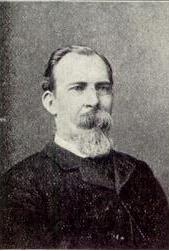
Capt.
Binkley was born in Davidson Co. TN, May 3, 1837. He enlisted July, 1861,
in the "Hatchie Hunters," 22nd Tennessee Infantry, and on May 8, 1862, he was
elected First Lieutenant. On June 17, 1862, the 12th and 22nd Tennessee
Regiments consolidated, at which time he was promoted and placed in command of
the "Hatchie Hunters" and "Harris Guards." The company engaged in the
battles of Belmont, Corinth, Richmond and Perryville, in Kentucky; of
Murfreesboro, Chickamauga, and Missionary Ridge, in Tennessee, and in nearly
every engagement between the latter point and Atlanta, under Gen. Joe Johnston,
and subsequently with General Hood at Jonesboro, GA., at Franklin, TN, and
Bentonville, NC.
Capt. Binkley was paroled at Macon, GA, May 11, 1865, and returned to his home near Nashville where he at once engaged in commercial pursuits, in which he has been very successful. In Aug. 1873, he was elected Register for Davidson County, which position he held for eight years, and in 1883 he was elected City Tax Assessor for a term of two years. He has been engaged in the Abstract Title business since 1885, and is now General Manager of the Nashville Title Company.
Capt. Henry Clay Binkley Ancestor of Compatriots: Terry Binkley, James E. Binkley Sr., James E. Binkley Jr.
The following is from the April 16, 1934 edition of the “Nashville Banner” newspaper of Nashville, Tenn.
Funeral for Capt. Binkley To Be Tuesday
Forrest Cavalryman Had Enviable Career as Soldier and Citizen
Funeral services for Capt. Henry C. Binkley, 86, one of the last of Forrest’s cavalrymen, who died at his home, 902 Chickamauga Ave., Sunday, will be held from the residence Tuesday at 10 a.m. Services will be conducted by the Rev. John F. Baggett, and the Rev. T. C. Ragsdale, with burial in the family cemetery near the Hermitage.
Capt. Binkley was born and reared near
Nashville, and spent his life here. He retired five years ago as assistant
manager of the Security Title Company, with which he had been connected since
the company organized in 1894. Survivors are a son, J. H. Binkley, and two
granddaughters, Misses Gladys Ree and Mary Evelyn Binkley. Active pallbearers will be Edwin L. and S.
H. Haynes, Ben Binkley, Ben J. and H. Barnett Carver, and Allen Mason. Honorary pallbearers will be members of
Company B, United Confederate Veterans, and Ernest Walton, J. M. Whitsett,
General Harry Rene Lee, Henry Thornton, W. W. Porter, K. T. McConnico, Carson
Bradford, P. D. Houston, Paul M. Davis, J. D. Torrey, C. B. Whitworth, Sanford
Duncan, George I. Waddey, John Gaffney, Jr., J. B. Daniels, R. R. McClure, W. M.
Lingner, Jordan Stokes, Walter Stokes, Thomas Malone, E. B. Rucker, W. E.
Norvell, Jr., S.E. Linton, W. P. Cooper, H. H. Hughes, T.G. Chase, Judge J. D.
B. DeBow, Congressman Joseph W. Byrns, Mayor Hilary E. Howse, Judge Litten
Hickman, James G. Stahlman, L.A. Bauman, J. W. Wagner, and Noah W. Cooper.
Enlisting at the age of 15, when the War Between the States had turned its second year, Captain Binkley served in the brigade of Col. James W. Starnes in Forrest’s division. The youth was with the remnants of Joe Johnston’s army in North Carolina just before it was captured, and then was part of the escort for Jefferson Davis, President of the Confederacy, through North and South Carolina. At Washington, Ga., he was with the last of the gray troops to be captured and was paroled. Captain Binkley was one of the last of Forrest’s troopers.
Captain Binkley was commander of Company B, United Confederate Veterans. He was always full of old war stories and at his desk nearly every day before his retirement, could be seen some old veteran sitting, talking over old times. He always had a happy greeting for all, a word of good cheer for every old soldier and comrade. Company B is composed of veterans of many different companies and brigades. It wears the old rebel uniform to all reunions and is in demand at many public functions. It has been through the individual efforts of Captain Binkley that this company has been able to attend the annual reunions in recent years. He took great pride in his company and in different ways provided for the transportation to and from the reunions.
One of Captain Binkley’s best adventures happened when he was a boy, scarcely fifteen years old, and before he had joined the army. He was born and reared ten miles from Nashville on the Stewart’s Ferry Pike, near the Hermitage. He was at home with his father, Joseph Binkley, in 1863. His brother, Benjamin F. Binkley, had joined the army, had become a captain, and had been in many fights.
In March, 1863, great distress prevailed in the Binkley home, for they had not heard from Ben in months. Joseph Binkley then asked his son, Henry (Captain Binkley) if he would not venture through the lines and find out about Ben, whether he was dead or alive.
On this trip Captain Binkley went through many hardships, walking most of the way. He was taken to Lebanon on a horse and from there walked to Tullahoma, where he had learned that the troops were stationed. When he reached Tullahoma he was informed that his brother had been ill and had been removed to a hospital in Rome, Ga. He then took a train to Chattanooga, and from there to Kingston, Ga., he made his way in a box car full of wounded soldiers. He walked from there to Rome. He later found his brother on the outskirts of Rome after many harrowing experiences in keeping out of the way of the Federal troops, who were in possession of the town at that time.
In 1924 Captain Binkley celebrated his golden wedding anniversary. He married Miss Ree J. McGee in Chicago on August 16, 1874. Mrs. Binkley died in 1928.
Captain Binkley was born in Davidson County November 25, 1847. He was a member of the 4th Tennessee Cavalry (Starnes) and surrendered with the latter’s command. In 1861 he joined Capt. Carroll Martin’s company, but on account of his age, 13, he was not allowed to leave. In June, 1863, he joined Capt. James Payne’s company in Morgan’s Cavalry in Wilson County. It disbanded and he was attached to Company B of the Second Kentucky battallion under Capt. J. B. Harris. In Company B of the Fourth Tennessee Cavalry, he was under Col. McClemore in Dibrell’s brigade.
He took part in the Battle of Chickamauga, Rockyface Ridge, Resaca, and all of the engagements of General Wheeler’s command from Dalton, Ga., to Atlanta, and from Stone Mountain to Columbia, S.C. He was never wounded. He was paroled at Washington, Ga., on May 10, 1865
Capt. Elon God Blackmer Ancestor of Compatriot Bob Blackmer.
Elon was born in the late 1830’s and was raised in Wheatland, Monroe County, in northwest New York. According to the U. S. Census of 1860 he still resided in Wheatland. At a later time, he traveled to Rowan County, North Carolina, probably following his half cousin, Luke Blackmer. Luke Blackmer was a promising attorney who had been living in Rowan County since about 1850. It is possible that, with the winds of war coming, Elon knew his heart was with the Cause of the South and decided to relocate to lend himself to that cause. Shortly after moving to North Carolina, on May 16, 1861, Elon God Blackmer, at the age of 22, enlisted in Company F, of the 7th North Carolina Infantry Regiment, and was commissioned a 2nd Lieutenant. He would later be commissioned a 1st Lieutenant. His regiment would participate in many battles including, New Bern, Fort Macon, Hanover Courthouse, Richmond 1862, Gaines Mill, and Frasier’s Farm. It was here, on the third day of battle at Frasier’s Farm, that Lt. Blackmer was wounded and lost an eye. This wound may have caused him to require time for rehabilitation or he may have continued to fight. If he had continued to fight, he would have been involved in the Battles of Harrison’s Farm, Malvern Hill, 2nd Manassas, Fredericksburg, Harper’s Ferry and Sharpsburg. However, he resigned from the 7th N.C. Infantry and joined Company G, of the 66th North Carolina Infantry Regiment as a Captain and the Company Commander.
The 66th Inf. Regt. Was organized in November, 1862 at Kingston, N.C. by consolidating the 8th Partisan Rangers and the 13th Infantry Battalion. Its men were from the counties of Orange, Nash, Franklin, Wayne, Lenoir, Carteret, Jones, Duplin, and New Hanover. The unit was attached to General J. G. Martin’s and Kirkland’s Brigade. The 66th Infantry Regiment had many engagements, including Newport Barracks, Cold Harbor, the Petersburg Siege, Burgess’ Mill, 1st and 2nd Fort Fisher and Bentonville.
On April 20, 1865, the 66th North Carolina Infantry Regiment surrendered at Durham Station, Orange County, North Carolina.
After the war, Captain Blackmer became a farmer in Rowan County, N.C. His honorable life came to an end at the early age of about 30. According to bible records, Elon God Blackmer died on September 21, 1865, in Morganton, North Carolina, possibly due to wounds sustained during his support of the valiant Cause of the South.

7th North Carolina Infantry
Pvt. Benjamin Anderson Fussell
Benjamin Fussell, the ancestor of Compatriot Lewis Fussell, was born on March 4th 1833, in Irwin County, Georgia. Coincidentally, it was near Irwinville in 1865, where the great chieftain of the Confederacy, Jefferson Davis, was captured by the Federals.
At the beginning of 1857, Benjamin came to Sumter County, Florida and engaged in farming and raising cattle. It wasn’t to last very long though. With the election in 1860 of the radical Republican, Lincoln, the fuse to war had been lit. In December of that year, South Carolina was the first to boldly declare her independence and start the secession movement. Next was Mississippi on January 9th, 1861, followed the next day by Florida. All over Dixie, young men began to fill the ranks of the newly formed Confederate States Army. 29 year-old Ben Fussell answered the call to arms, and enlisted in Capt. W.W. Slone’s Company “F” of the 7th Florida Infantry Regiment on May 7th, 1862 in Orlando. Ben served for a year in this company and was then discharged by reason of furnishing a substitute. He must have had a family emergency or some other compelling reason for leaving the service, since he re-enlisted in Company “H” of the 1st Florida Reserves on May 5th 1864 in Sumterville. He served in this unit to the end of the war and was discharged May 12th 1865 in Madison, Florida by Capt. John N. Johnson
When the war ended, Ben came back to Sumter County and settled at Webster. He met and married Miss Elizabeth Sease in 1886. To this union was born six daughters and one son. The family owned and maintained 200 acres of land in Webster, along with 2 horses and 50 head of cattle up to 1909. The Lord called Ben home on May 20th 1910.
Benjamin Anderson Fussell was one of many of the Fussell family that served in the Confederate Army. The Fussell’s are a long-time Florida family with a rich heritage of service to God, family, and country.
Lt. Gilbert Perry Gordy Ancestor of Compatriot: Reverend Dun Gordy
Gilbert Perry Gordy was from Chattahoochee County, Ga. He married Martha S. George, Sept. 30, 1859 in a ceremony performed by W.B. Willis, J.I.C. He joined the Chattahoochee Rangers to help the Confederacy. They left Columbus on October 29, 1861. This unit was part of the 3rd Georgia Cavalry and was assigned to Wheeler's Cavalry Brigade. The record of this regiment shows duty at the battles of New Haven, Perryville, Murfreesboro, Tullahoma Campaign, Chickamauga, Chattanooga, Knoxville Siege, Atlanta Campaign and Siege, Sunshine Church... Lt. Gordy was wounded in the left leg, apparently in the Atlanta Campaign and was sent home to recover. He died in Chattahoochee Co. on Oct. 4, 1864 from wounds sustained in battle. He is buried in Chattahoochee Co., Ga.
Gilbert Perry was one of eight brothers, five of whom served the Confederate States of America in military duty. One brother was killed and another wounded. His youngest brother was Rev. Dun Gordy's great grandfather, George Gaines Gordy.
Below are the pictures taken by Rev. Gordy of the uniform of Lt. Gilbert Perry Gordy. The uniform has been "preserved" in a cardboard box that was mailed from Oklahoma by the soldier's daughter in 1922. It was donated to the Kashita Chapter of the United Daughters of the Confederacy with the instructions that his widow wanted the uniform to return to the county of his birth. When that chapter disbanded they donated all their artifacts to Chattahoochee County. It is in the custody of the Probate Judge Kenneth Van Horn who has taken interest in having it preserved and displayed.
The uniform consisted of a black leather cavalryman's hat; butternut officer's jacket with 14 brass buttons and several sweat and blood stains; black wool pants with several mends, evidence that the waist had been taken in several times as Lt. Gordy lost weight, the seat nearly worn out, and just below the left knee is the bullet hole, later patched by different colored thread; a pair of socks; part of the belt with the buckle and hanger for his saber; the pin used to hold his tunic; a red bandana handkerchief in the pocket of the jacket; folded in the bandana was a 58 cal. minnie ball that was identified by the attached note that said it was the bullet that caused his death.
2nd Lt. Fredrick Southgate Hipkins Ancestor of Legionnaire Thomas Kelly.
Fredrick
was born in Norfolk, Virginia in 1844.
At the start of the war in 1861, Fredrick enlisted in Captain Taylor’s company
of Virginia Volunteers, also known as “The Young Guards”. When this unit
disbanded in 1863, Fredrick held the rank of 2nd Lieutenant. He
then went to Richmond and enlisted in Company
C of the 43rd Virginia Cavalry, the immortal “Mosby’s Rangers”.
He held the rank of Sergeant/Scout until near the end of the war.
Col. Mosby had given orders that no one was supposed to go into Leesburg, Virginia. Fred had a girlfriend in Leesburg and went to see her, orders notwithstanding. When Col. Mosby found out, he sent two armed men to bring Fred back. Upon his return to the regiment, he was reduced in rank to Private.
Fredrick served until the end of the war, and was “paroled” at Winchester, Virginia in 1865.
After the war, Fred became an Episcopalian minister in the town of Swanton in Garrett County, Maryland. He later moved to New York to work at the Cotton Exchange there.
In 1913, Fred was the guest speaker at the Confederate Officers Reunion at the Hotel Astor in New York City. The book “Mosby’s Rangers” by James J. Williamson, gives an account of Fred and his brother John, (who also served under Mosby). The men of Mosby’s regiment liked Fred so well that they wrote a song about him, and it is in the book by Williamson.
Fredrick Southgate Hipkins passed away in New York in 1928.
Pvt. Richard Hipkins Ancestor of Legionnaire Thomas Kelly
Richard Hipkins was born in 1841 in Norfolk, Virginia. Before the War Between the States, Richard had been a clerk in Norfolk. The belligerence of the North changed all that though, and Richard along with brothers John and Fred, joined the Confederate States Army in April of 1861. The dust had not yet settled on Fort Sumter before the Hipkins boys were enlisted to fight the vile invaders of their beloved South. Richard was assigned as a Private in Company “G” of the 6th Virginia Infantry. At 2nd Manassas, Richard was wounded terribly, resulting in a shattered elbow. He was treated at Richmond’s Hospital #9, and then allowed a convalescence leave for several months. During this time he was able to visit his mother who was living in Townsville, N.C. as a refugee from the Yankee onslaught.
The wounded elbow rendered Richard unfit to return to field duty, but he requested and was granted a return to service as a clerk in Gen. Longstreet’s headquarters, where he served until the end of the war, at which time he was selected to represent his unit at the surrender ceremonies at Appomattox.
After the war, Richard spent several months in Vicksburg, Mississippi with friends he had served with in Mosby’s regiment. He later moved back east to Baltimore and then to Pikesville, Maryland where he entered the Confederate Soldiers Home. While living in Maryland, he discovered that his brothers were living in New York City and working at the Stock Exchange. Richard followed suit and moved to New York City where he lived at 313 2nd Avenue and also worked in the stock exchange business. Sadly, Richard began to have mental problems and had to move back into a care facility, the Robert E. Lee Confederate Soldiers Home in Richmond, Virginia. This was to be his final home. Richard died at the home on July 19, 1924, and was buried in Plot 552 at the historic Hollywood Cemetery in Richmond. As a fitting tribute to a Confederate soldier and patriot, the Hipkins family installed a new, more suitable marker on his grave in 1996.

Lt. Gen. John Bell Hood 3rd Cousin of Stephen Robertson
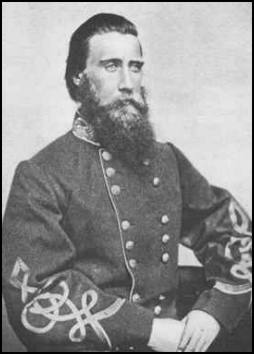
John
Bell Hood was born June 29, 1831. He graduated from West Point in 1853 and
served in the U. S. Army until he resigned to join the Confederacy in 1861.
He was appointed to command the Texas troops and rapidly demonstrated great
heroism in combat, winning quick promotions. Gravely wounded at Gettysburg
and Chickamauga, Hood went on to command in Georgia. Hood retired in 1865
and died August 30, 1879, to be remembered as a great and patriotic son of the
Confederacy.
Lt. William Andrew Hoss Great Grandfather of Compatriot Robert Moody
William "Bud" Hoss was born
Feb. 17, 1841, the fourth of six children of Jacob Henry Hoss and Sarah
Vance Mitchell. Though his parents were from Tennessee,
Bud
was born in Cedar Bluff, Cherokee County, Alabama where his father, Jacob,
worked as a carpenter and mother, Sarah, ran an inn. During the war, Jacob
Hoss was a Major in the CSA and during part of 1863, while still a Captain,
served as military Governor of Rome, Ga. for the Confederacy. On Aug. 16, 1861,
William Andrew Hoss enlisted at Centre, Alabama, the county seat of Cherokee
County. He enlisted as a Private in Co. H, "The Cherokees" of the 19th
Alabama Infantry Regiment commanded by Colonel (later Lt. General) "Fightin'
Joe" Wheeler. After over 5 months of training and getting ready for
battle, the 19th was ordered to Corinth, Miss. to engage in the Great Battle of
Shiloh, fought April 6th and 7th, 1862. Pvt. Hoss survived his baptism of fire
and went on to fight in many more battles.
The 19th participated
in many conflicts from Murfreesboro to Atlanta, was with Hood in Tennessee, and
fought at Bentonville, North Carolina. It lost fifty-four percent of the 650
engaged at Shiloh, and reported 151 killed and wounded at Murfreesboro and 192
at Chickamauga. In December, 1863, the regiment contained 347 men and 228 arms.
It was badly cut up in the battles around Atlanta and many were captured at
Franklin. Along the way Pvt. Hoss
made it through the ranks to be promoted to 1st Lieutenant and transferred to
Company I of the 19th regiment. On May 2, 1865 the regiment was disbanded at
Union Point, Georgia.
Only 76 men were
present when it surrendered. Lt. Hoss was paroled at Salisbury, NC. Bud Hoss then returned to civilian life and
began to raise a family. Bud was blessed with eleven children while having
to endure the early passing of two wives of his three marriages. Lt.
William Andrew Hoss made his final muster on April 18, 1922 and is buried in the
1st United Methodist Church Cemetery in Thomson, McDuffie County, Georgia.
You WILL be remembered!

Enoch Wiley
Hurst G.G.Grandfather
of Harry D. Hurst
Teamster 9th Florida, Company "E" Confederate States Army
Enoch was the 3rd child of nine born to William Broad Hurst and Sarah Wilder.
He was born in Screven County, Georgia on June 10, 1810. According to his
Confederate pension application in 1907, he came to Florida at the age of 5
years.
During the Seminole Wars in Florida, he and his father served with Capt.
Redding's 1st Fla. Militia. On April 6, 1838, he was shot through the thigh and
his horse was killed from under him at Thomas Mill Hammock in Taylor County,
Fla. Enoch enlisted again in the militia on Sept. 23, 1839 under Capt. Wm.
Newborn and once more on Aug. 10, 1840 under Capt. John Townsend.
During his militia service, Enoch was described as being 5 ft. 10 in. tall,
having fair skin and blue eyes.
Enoch enlisted in the Confederate Army on August 7, 1863 under Capt. Asa A.
Stewart at Lake City, Florida. His unit became the Florida 6th, Co.
"E". Under this command, he served as a teamster, mostly in the
area of Palatka, Olustee and Lake City. After the Battle of Olustee, in
1864, the 6th was sent to Virginia and was reorganized into the Florida 9th.
During the fall months of 1864, Enoch
was wounded and captured near a place called Ely's House. He was sent to a
Washington area hospital until the war's end.
After the war, he returned to Suwannee County Florida and worked with his son
Wiley Enoch Hurst in a saw mill. Enoch died on January 24, 1911 and is
buried in the Friendship Baptist Church cemetery in the Pine Mount community,
south of Live Oak, Florida.
Pvt. Levi Berry Long Ancestor of Compatriot Paul Mott
Levi Berry Long was born in Tennessee, on April 13, 1835. When the war came in 1861, Levi, who had since moved to Texas, joined the Confederate Army along with thousands of patriotic Southerners from all across Dixie to fight the Yankee invaders. Pvt. Long served with Co. B, 15th Texas Cavalry Volunteers. He survived the war, and later moved to the Indian Territory, now called the State of Oklahoma. Levi died on May 13, 1893 and is buried at Atoka, Oklahoma. His wife was a school teacher who made and smoked small clay pipes and occasionally a corn-cob pipe. She lived until 1928. Compatriot Mott has personal recollections of seeing her a couple of times when he was a small child.
QtrMstr. Sgt. James M. McClelland, Pvt. William R. McClelland Ancestors of William S. McClelland
On March 10, 1862, companies from Henry County, Georgia and nine other nearby counties formed the 44th Georgia Infantry Regiment. On May 6, 1862, two men from near McDonough, GA enlisted for 3 years or the war. James M. McClelland, 19, and William R. McClelland, 21, joined Co. I 44th GA Inf. James became a Quartermaster Sergeant and William remained a private.
They fought with the Army of Northern Virginia from June 26, at the Battle of Mechanicsville, through every battle in which the ANV was involved, surrendering at Appomattox Court House, April 9, 1865. Of the 1,115 original members of the 44th GA Infantry, when the end came that April day, only 62 were present for duty! James and William returned home to find their family farm, listed on the 1860 census valued at $1,000, destroyed, and their father, mother and little sister, Lucy, facing the horrors of Reconstruction. Their mother would pass away not long after, due to the strain caused by the damages and strain brought on by the Yankee army. Lucy, 17, would face an uncertain future, her childhood lost to the War and the few eligible men left, either old men or young men who had been maimed physically or mentally by the War.
Pvt. William S. McGillivray Ancestor of Compatriot Steve McGillivray
William S. McGillivray was born in Charleston, S.C. As a young man, he joined the Confederate army, like so many other true sons of the South. Motivated by the desire to maintain a free, constitutional republic as was intended by the Revolutionary forefathers, William offered his strength to the 3rd (Palmetto) Battalion, Co. B, South Carolina Light Artillery. Pvt. McGillivray served in the defense of Charleston at Fort Sumter under the immortal Gen. P. G. T. Beauregard during one of the most vicious of the ongoing assaults on the fort by the Yankees. During the bombardment of the fort in September, 1863, Pvt. McGillivray was about to open a powder magazine door when it was struck by an incoming shell. The ensuing explosion blasted the key from William’s hand directly to his head. Thankfully, Pvt. McGillivray was not seriously injured. As an interesting side note, Compatriot Steve McGillivray reports that his aunt still has that key in her possession to this day. William later transferred to Co. I of the 3rd South Carolina Cavalry and was attached to the Department of South Carolina, Georgia and Florida. The 3rd S. C. Cavalry helped to defend Savannah from the infamous lunatic, Sherman. Towards the end of the war, William and the 3rd S. C. Cavalry were placed in the command of Gen. Joe Johnston in the Army of Tennessee. They participated in the last battles of the Confederate army at Averasboro and Bentonville, North Carolina, once again confronting the psychotic Sherman and his henchmen. For whatever reason, only Providence knows, the Southern patriots were not able to stem the tide of tyranny and were defeated. Pvt. William S. McGillivray did his duty as a true son of the South and then returned to his home in Charleston, South Carolina. He lived out the rest of his life in the beautiful Low Country and when the Lord called him to rest, was buried there in the land he loved and the land that he shed his blood to protect.
Pvt. Henry Lucius Mills the Great Grandfather of Compatriot Bill Mills.
Henry Lucius Mills was from Troy, in Pike County, Alabama. His parents William and Elander had moved to Pike County from North Carolina. Henry grew to manhood likely never venturing very far from his home. He met Miss Martha Ann Lee as the storm of change was on the horizon. They were married in White County, Alabama on Feb. 14th, 1861. The storm arrived for Henry when he decided he must leave his new family and join the fight for his homeland.
He enlisted as a Private in Capt. James P. Nall’s Company A of the 39th Alabama Infantry Regiment about the 13th of March, 1862. The 39th was newly formed at Opelika, Alabama with its members being drawn from Pike, Barbour, Henry, Walker and Russell counties. Pvt. Mills was immediately sent north with the regiment and assigned to General Gardner’s Brigade to fight in the Kentucky Campaign where they saw little action. The regiment was later under the command of Generals Deas, G.D. Johnston, and Brantley. The 39th Regiment was prominent in the arduous campaigns of the Army of Tennessee from Murfreesboro to Atlanta, moved with General Hood into Tennessee, and fought its last battle at Bentonville. Henry’s unit reported 95 casualties at Murfreesboro and lost thirty-one percent of the 310 engaged at Chickamauga. During December, 1863, the regiment totaled 337 men and 219 arms. By the time of surrender, April 26th, 1865, less than 90 officers and men remained.
Private Henry Lucius Mills returned home to his young bride to try to pick up where life had spun to a halt 3 years earlier. Times were hard after the war and by the early 1870’s Henry was looking toward the growing territory of Florida where tales of warm weather, land and opportunities abound. Henry and Martha settled near Pinemount and Live Oak in Suwannee County, Florida in 1875 and lived there many years raising their family.
Former Private Henry Lucius Mills of Company A of the 39th Alabama Infantry Regiment passed his final muster on December 24, 1901 at his home near Pinemount in Suwannee County, Florida leaving behind his wife Martha and many descendants.
Pvt. William Riley Milton Great Grandfather of Judge Advocate, William A. Milton, Jr.

William Riley Milton, was born on December 5, 1845, in Apling, Georgia.
His sister, Ann, married John Turner on Christmas Day, 1845, and moved to the Umatilla, Fla. area.
The family history states that William Riley moved to Florida in 1855. While we are not certain whether William Riley was residing in the Umatilla area or the Madison area during the War Between the States, we do know from the Confederate Archives that he was enlisted by Lieutenant Hart at Madison, Florida, as a Private in Company B, Fifth Regiment, Florida Infantry, on May 3, 1864: his enlistment was for a period of three years. His military records indicate that he was injured during military service and spent time in the hospital.
He was captured at Farmville, Virginia, on April 6, 1865, and was paroled at Newport News, Virginia, on June 25, 1865, after taking an oath of allegiance to the United States. The Confederate records indicate that at the time he was paroled, his place of residence was listed as Sumter County, Florida.
With regard to his injury, he stated that it was as a result of "being thrown from my horse the year of surrender." Later medical examinations revealed that he suffered from a hernia and from a fracture of the right thigh bone which was poorly set. He did qualify for a veteran's pension from the State of Florida which was granted in 1902.
It appears that William Riley Milton was a part of Finagans' Brigade and the famous "Whirlwind Brigade." This Brigade was involved in most of the major battles throughout Virginia during the last years of the war.
After the war, William Riley Milton returned to what is now Lake County, Florida, and was married in Leesburg, Sumter County, Florida, on January 3, 1869, to Mary Miller. He made Homestead Entry no. 2394 on November 13, 1875, and on February 13, 1884, received a grant of 169 acres in Orange County, Florida.
William Riley and Mary Milton had six children: all born in Umatilla, Florida. Their son, William Andrew, was the father of W. A. Milton, Sr., and grandfather of W. A. Milton, Jr.; both born in Grand Island, Lake County, Florida.
William Riley and Mary Milton were charter members of the Live Oak Baptist Church, which was located near what is now Dona Vista, Florida.
William Riley Milton was typical of the other young men his age at the time. He entered the Army during the closing days of the war when the outlook was bleak for the South. He was fighting because his State was being invaded. He and the other men like him paid a terrible price and set examples of courage and self-sacrifice which we should continue to hold dear in their memory. William Riley Milton suffered the rest of his life from the injury sustained during the war: that did not prevent him from being a contributing member in his community and setting a good example for those around him. He died in 1907 and is buried in the Evergreen Cemetery in Daytona Beach, Florida.
Jesse P. Shamblin Ancestor of Cmdr. Terry Binkley and 1st Lt. Cmdr. Jim Binkley
Jesse Shamblin was born in Grass Lick, Jackson County, Virginia (now West Virginia), in 1838. Jesse was described in his service record as having a dark complexion with dark hair and brown eyes and being about 5’9”. He enlisted in “The Elk River Tigers”, Company E of the 22nd Virginia Infantry on July 30th 1861 at Charleston, (W) Virginia. The 22nd was commanded by Col. George S. Patton, the grandfather of Gen. George S. Patton of World War Two fame. Jesse was wounded and taken prisoner at the Battle of Droop Mountain on November 6th 1863, but escaped and returned to his home at Osbornes Mills. While recuperating from his wounds, he found time to get married to Miss Olive Jane Reed. Jesse returned to his regiment to defend Virginia from the blue horde, but was captured again at Charleston on April 8th 1864. Arriving at the Federal hell-hole known as Camp Chase on May 10th, he spent the remainder of the war in prison. Being one of the lucky ones who survived incarceration in the notorious prison camp, Jesse returned to his wife and farm at Osbornes Mills in Jackson County. He had done all he could to secure independence for the South, but sadly, it was not to be. Jesse and Olive had ten children and lived out the rest of their lives in peace.
Lt. Col. Richard W. Singeltary Ancestor of G. Richard Singeltary
The following article was printed in the Nov.-Dec 1992 issue of Confederate Veteran. Submitted by C. E. Avery and Richard Singeltary
Richard was born the 8th child to the
Rev. Singeltary and his wife in Washington,N.C. on Feb.19,1837. While growing
up,he received a good education, obtaining a degree from the University of North
Carolina in 1858. When war came, three of the
Singeltary brothers enlisted in
the 27th NC Inf. Regt. Brothers George and Thomas were elected Colonel and Lt.
Colonel of the regiment, while Richard was elected 1st Lieutenant on April
21,1861. Four months later he was elected Captain of Co. H. When his brothers
resigned in January 1862, to join the 44th Regt., Richard was elected Lt. Col.
of the 27th and in March, the regiment participated in the Battle of New Bern.
In May, the 27th was ordered to Virginia and became part of Walker's Brigade,
Heth's Div., A. P. Hill's Corps. Though not actively engaged in the Seven Days
fighting around Richmond, the regiment did receive some casualties from random
shells shot by the enemy. In September they marched into Maryland. At Sharpsburg
(Antietam), the 27th entered the battle with 325 officers and men. Two hundred
three men were killed or wounded. Richard was severely wounded on Sept. 17th.
His wound disabled him for several months, necessitating his resignation in
November. The resignation was not approved until December, and by January 1863,
he had recovered enough to volunteer for service again. He was appointed Captain
of Co. H, 44th N. C. Inf. It was in this regiment that Richard's brother
George was killed in 1862 after resigning from the 27th. The 44th was part of Kirklands' Brigade, Heth's Div., A. P. Hill's Corps. During the Battle of the
Wilderness on May 6th,1864, Thomas Singeltary, Richard's other brother, was
wounded. Four days later, Richard was again wounded, during the Battle of
Spotsylvania Court House. His wound again prompted Richard to tender his
resignation from service in September, but in his resignation letter he made it
clear that he would again join the service as soon as he was physically able. On
March 21,1865, he accepted an appointment as 2nd Lt. of Artillery, which was
approved by the Secretary of War on March 31st, a week before Richmond fell.
After the war ended, he returned to North Carolina, married, and engaged in
farming for a while in Edgecombe Co. In 1868, they moved to Wilson, where
Richard practiced law. In 1874 he purchased a weekly newspaper, "The Plain
Dealer", which he ran until the following year. He was elected to the
Constitutional Convention of 1875, and to the North Carolina House of
Representatives in 1876. In 1886 he moved to Conant, Florida, where he ran a
store, post office and pharmacy. On July 21, 1892, Richard died and was buried
at Rose Hill Cemetery, Kissimmee, Florida.
Pvt. William R. Surface Ancestor of Cmdr. Terry Binkley and 1st Lt. Cmdr. Jim Binkley
William R. Surface is the 3rd Great Uncle of Jim and Terry Binkley. William
R. Surface enlisted in the Confederate
Army
on June 4th
1861 in Roanoke, Virginia. He joined the 42nd
Virginia Infantry, Co. E “The Dixie Grays”. He was hospitalized on August
31st 1861 for unknown reasons. On March 8th 1863,
Pvt. Surface was detailed at Richmond Hospital in Richmond, Virginia, presumably as a nurse. He was
then detailed as a nurse and guard at White Sulphur Springs, (W.) Virginia. On
May 5, 1864, Pvt. Surface was wounded at
the Battle of The Wilderness. He
was “paroled” on June 21st 1865 at Charleston, W. Virginia.
Among the many battles the 42nd Virginia Inf. took part in were
Winchester, Port Republic, Spotsylvania Court House, Manassas,
Antietam, Fredricksburg, Chancellorsville and Gettysburg. William’s
younger brothers, Charles and H. C. Surface (the Binkley’s GGGrandfather),
served in the 54th Virginia Infantry, Company K. Several of the
Surface boy’s cousins also served in the Army of Northern Virginia, including
Sgt. James H. Surface, 24th Virginia Inf. Co. F, who was killed at
Williamsburg, Va., coincidentally on May 5th 1862, exactly 2 years to
the day before William was wounded at The Wilderness. Pvt. Jacob A.
Surface, 36th Va. Inf. Co. F, was captured at Waynesboro, Va. and
sent to prison at Fort Delaware. Pvt. Samuel D. Surface, 11th
Va. Inf. Co. F, was severely wounded at 2nd Manassas. We are
very fortunate to have this war-time photograph of one of our Confederate
Heroes.
Pvt. Andrew E. Wade Ancestor of Tommy R. Carlisle Sr. and William R. Carlisle
Andrew was born Dec. 15, 1840 in Georgia. Andrew Wade moved with his family to Linden in Sumter County, Florida in 1857. He enlisted in Capt. David Hughes, Company K of the 1st Florida Cavalry Regiment (later Infantry) January 10th, 1862.
In the spring of 1862, the 1st Regiment Florida Cavalry received orders to go north to Chattanooga, Tenn. On leaving Florida, all but three of the 1st’s companies voluntarily dismounted, including Co. K, to become infantry throughout the remainder of the war. Pvt. Wade was captured at the Battle of Chattanooga at Missionary Ridge on November 23rd of 1863 and arrived at Rock Island Prison on December 3, 1863. The prison was located the middle of the Mississippi River, near Moline, Illinois. The prison, built in mid-1863, received its first prisoners, 5,592 in all, captured at Lookout Mountain and Missionary Ridge. Rock Island Prison was considered by some to be the “Andersonville” of the north. On the day of the Confederate prisoners’ arrival, the temperature dipped to 32 degrees below zero with 94 of their number already suffering from smallpox and the entire group having been exposed. Undoubtedly, this was a terrible time for all. Pvt. Wade had received an injury to his back from a fall during the forced march over the Cumberland Mountains en route to Rock Island. The injury caused weakness to all his limbs and especially his left hip and leg, which would never entirely heal.
Pvt. Andrew Wade was able to endure the privations as a prisoner of war at Rock Island for over a year, when in early 1865 he was chosen for prisoner exchange in Richmond. After his exchange on Feb. 15th, 1865, he was admitted to Richmond’s hospitals in March, 1865. He was later given furlough to return home for a time.
He remained at home in Linden, Sumter County, on furlough when the end of the war came and was mustered out April 26, 1865.
Andrew E. Wade, now a private citizen, lived the rest of his life in Linden, Sumter County, Florida. He now resides in the Linden Cemetery, where he will continue to stand guard as one of the righteous of heaven. Private Andrew E. Wade, we will never forget!
General S. A. M. Wood Ancestor of Col. Sterling Wood

Sterling Alexander Martin
Wood was born March 17th, 1823 in Florence, Alabama. As a young man,
Sterling was educated by Jesuits and graduated from St. Joseph’s College in
Bardstown, Kentucky in 1841. He then took
up the study of law and began working as an attorney in
Murfreesboro, Tennessee,
eventually moving back to Florence, establishing a practice there. In 1851, he
was appointed solicitor for the 4th Circuit Court of Alabama. Then,
in 1857, he was elected to the State Legislature. Around 1860,
Sterling became editor of the
“Florence Gazette”. Instead of enjoying middle age and an easier life-style at
this time, Sterling, along with the rest of the South, was thrust into a
life-or-death struggle by the onslaught of the invading Northern armies. Joining
up with the Confederate Army, Sterling was elected Captain of Company K, the
“Florence Guards” of the 7th Alabama Infantry. At a ceremony at the
Masonic Hall in Florence on April 1st, 1861, Capt. S.A.M. Wood
graciously received a flag for the
company from Rev. Dr. Rivers who presented it on behalf of the ladies of
Florence as a token of their appreciation to the brave men who dared defend
their rights.
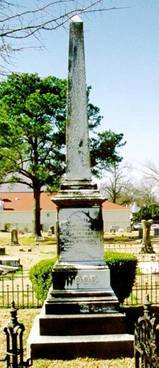
The
flag eventually became the property of John B. Weakley, who donated it to the
Alabama Dept. of Archives and History on October 7th, 1913.
The 7th Alabama Infantry was organized in May, 1861 at Pensacola, Fla. and consisted of eight infantry and two mounted companies. Sterling was promoted to Brigadier General on Jan. 7th, 1862. He served at Shiloh, was wounded at the Battle of Perryville and took part in the Battle of Stones River (Murfreesboro), and the Chickamauga Campaign. At Chattanooga on Oct. 17th, 1863, Gen. Wood resigned from the army for unknown reasons. He returned to Alabama and resumed the practice of law at Tuscaloosa. Soon after the war, he worked as an attorney for the Alabama Great Southern Railway. In 1882, Gen. Wood was again elected to the State Legislature and also taught law at the University of Alabama.
Gen. Wood passed away on Jan. 26th, 1891, at the age of 67. He was of the most noble type of Southern gentleman, learned in the words of law and in the clash of war, defending the rights of fellow Southerners.